How to Rank on AI Search in 2026: The Complete Playbook to Get Your Business Cited by ChatGPT, Perplexity & Google AI Overviews
Learn how to rank on AI search in 2026. A step-by-step playbook to get your business cited by ChatGPT, Perplexity, Gemini, and Google AI Overviews.

Your next customer might never see a list of blue links. They will type a question into ChatGPT, Perplexity, or Google's AI Overviews, read a single confident answer, and act on it. If your business is named in that answer, you win. If a competitor is named instead, you were never in the running, and you will not even see it happen in your analytics.
This is the shift every business owner is now waking up to, and it is exactly why learning how to rank on AI search has become one of the most important marketing questions of 2026. Search did not disappear. It changed shape. The goal is no longer only to climb to position one on a results page; it is to become the source the AI trusts enough to quote. Figuring out how to rank on AI search is really about earning that trust.
The good news is that this is learnable, and much of it builds on fundamentals you may already have. This guide breaks down how to rank on AI search step by step, what these engines actually reward, and the practical checklist you can start working through this week.
What "Ranking on AI Search" Actually Means
Before the how, the what. On a traditional search engine, ranking means your page appears high in a list. On an AI engine, there is often no list. You ask Perplexity "who are the best web development agencies in Bangalore" and it writes a paragraph naming a few, sometimes with citations, sometimes without.
So when we talk about how to rank on AI search, we really mean three overlapping things: being retrieved (the AI's crawler has your content and can pull it), being cited (your brand or link appears in the answer), and being recommended (the AI actively suggests you). A Reddit thread on r/SaaS captured this well with the idea of "Share of Model": ranking first on Google is meaningless if ChatGPT recommends your competitor ninety percent of the time.
That reframing matters. Knowing how to rank on AI search is less about a single keyword position and more about how often the machines mention you across all the questions your customers ask.
Why AI Search Is Different From Traditional SEO
AI engines do not think in pages the way Google's old index did. They assemble answers from patterns, entities, and trusted sources. Three differences shape everything about how to rank on AI search, and each one changes how you should approach your content
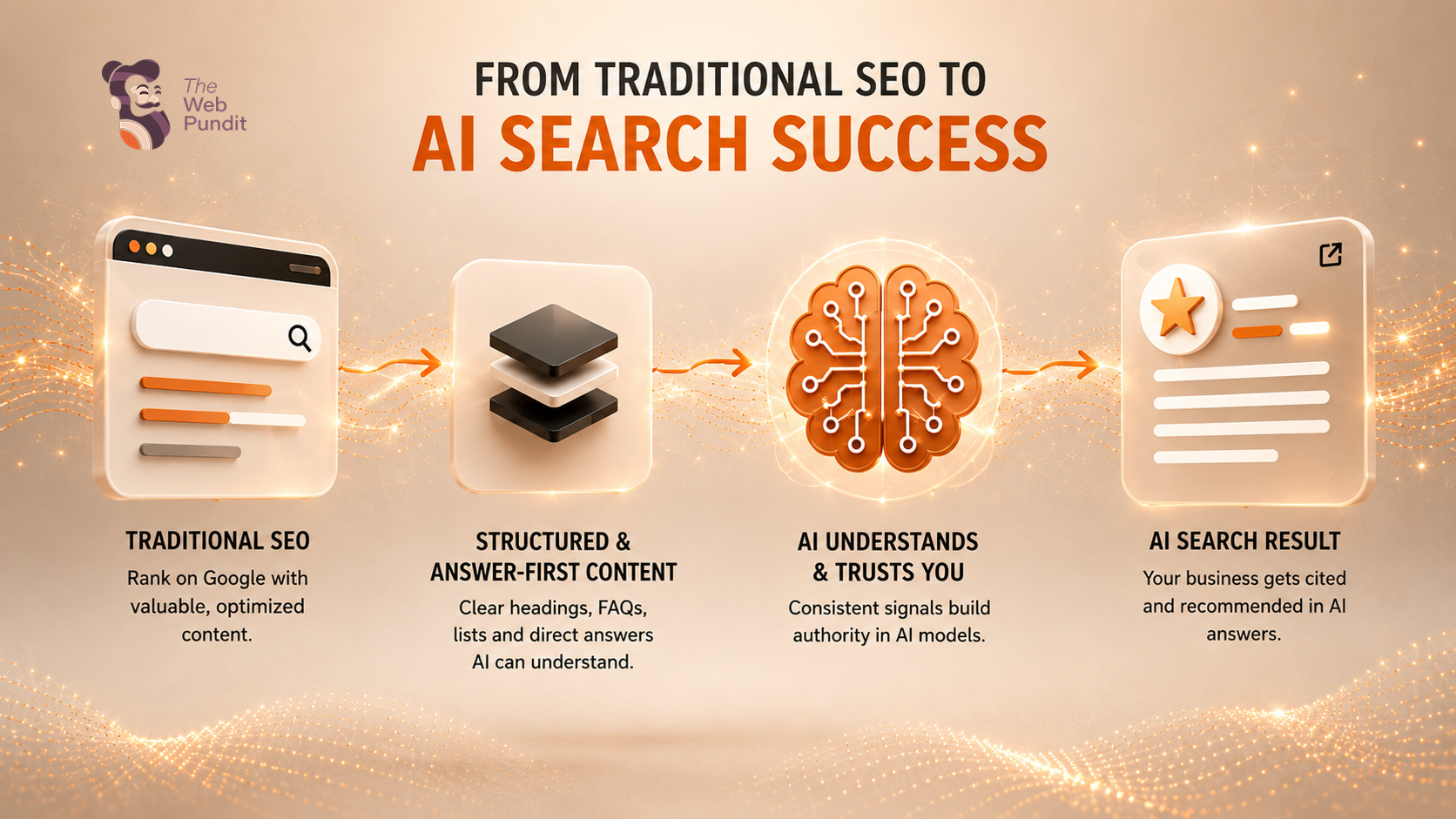
First, they favor direct answers over keyword-stuffed pages. An AI wants a clean, quotable sentence it can lift into its response, so how to rank on AI search starts with writing answers, not padding. Second, they lean heavily on structure. Clear headings, lists, and FAQ formatting help a model parse which part of your page answers which question. Third, they weigh authority and consensus. If several trusted sources describe your business the same way, the AI treats that as fact.
None of this erases classic SEO. As one digital marketing commenter put it, AI search looks for clear, authoritative signals like well-structured content and strong backlinks, and traditional SEO still helps you get there. The two work together, which is the single most reassuring thing about learning how to rank on AI search: you are not starting from zero, you are extending what already works.
How to Rank on AI Search: The Step-by-Step Playbook
Here is the practical sequence for how to rank on AI search. Work through it in order, because each step makes the next one more effective.
1. Make sure AI crawlers can actually reach you
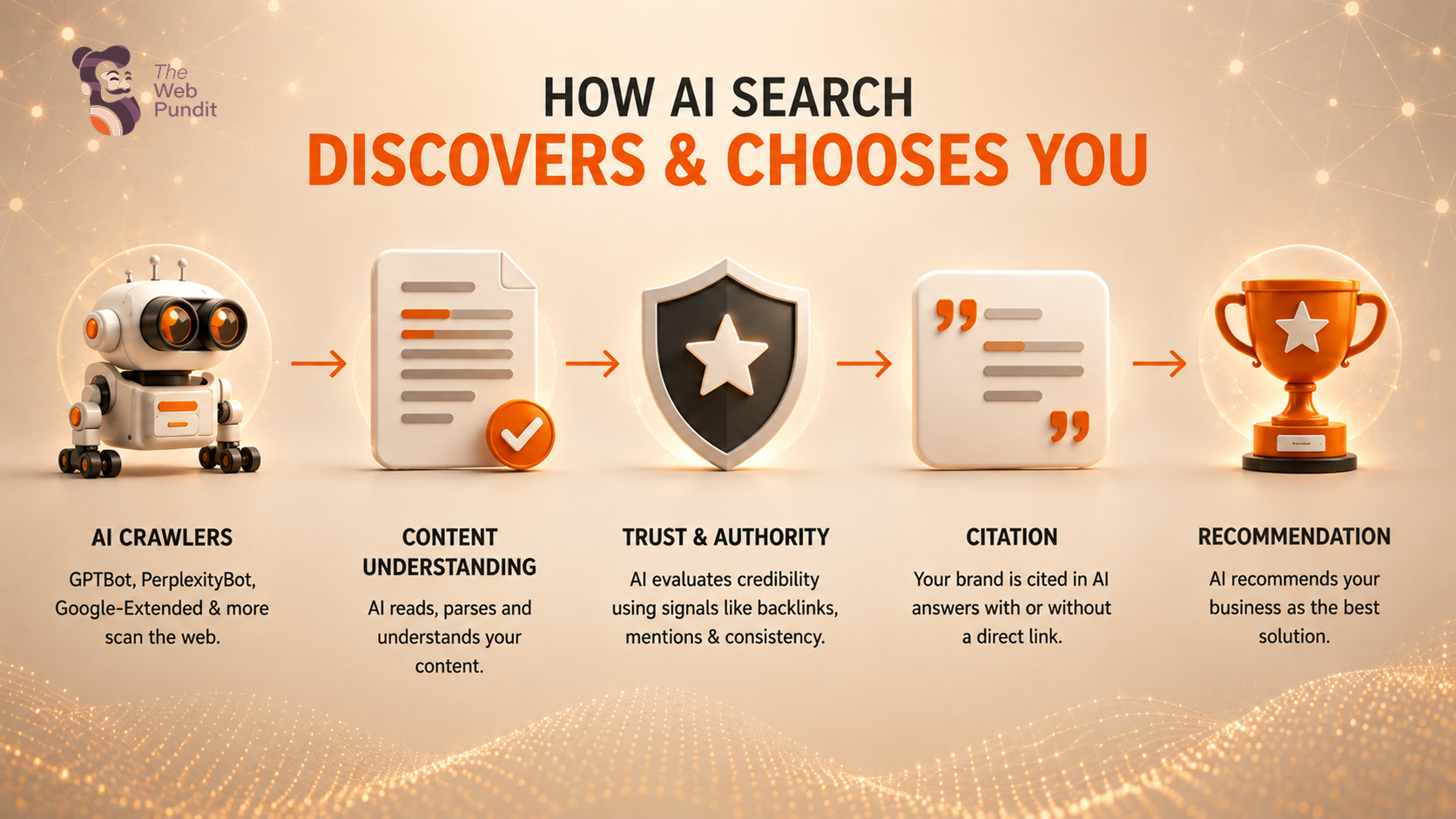
You cannot be cited if you cannot be read. AI engines use their own crawlers (GPTBot, PerplexityBot, Google-Extended and others), and many sites accidentally block them or hide content behind heavy JavaScript. Check your robots.txt, confirm your key content loads as real text rather than script-rendered elements a crawler might miss, and make sure your most important pages are fast and accessible. This is the foundation of how to rank on AI search, and it is the step most businesses skip.
It is worth doing an honest audit here. Open your robots.txt and look for any lines disallowing the AI user-agents named above; many site owners added those blocks during the early AI panic and never removed them. Then view a key page with JavaScript disabled to see what a simple crawler sees. If your core content vanishes, that content is effectively invisible to the engines you are trying to reach.
2. Rank in traditional search first
This surprises people, but the evidence is consistent: pages that already rank well on Google are far more likely to be pulled into AI Overviews. When people ask how to rank on AI search, this is the step they least expect and most need to hear. AI engines lean on existing search signals to decide who is trustworthy. So solid on-page SEO, a clean site structure, and quality backlinks are not separate from AI ranking; they are a prerequisite. If you want the deeper version of this foundation, our on page SEO checklist walks through it in detail.
3. Write in a direct, answer-first style
Lead each section with the answer, then explain. Instead of building up to a conclusion, state it in the first sentence and let the rest support it. This is how featured snippets worked, and knowing how to rank on AI search means leaning into that instinct even more strongly. When a model scans your page, it should find a clean, self-contained answer it can quote without editing.
4. Structure content for machines and humans
Use descriptive headings phrased as the questions people actually ask. Break complex points into lists. Add an FAQ section (like the one at the end of this post) because question-and-answer formatting maps almost perfectly onto how people query AI tools. A well-structured page is easier to cite, and when you are working out how to rank on AI search, easier to cite is the whole game.
5. Build topical authority, not one-off posts
AI engines reward sources that clearly own a subject. One good article is a data point; a cluster of interlinked articles on the same theme is a signal of expertise, and it is one of the most durable ways to rank on AI search. This is why building topic clusters around question-style keywords, as one DigitalMarketing user described after getting featured in AI Overviews, works so well. Depth beats scatter.
6. Use schema markup
Structured data (schema) labels your content for machines: this is an FAQ, this is a review, this is a local business. It helps AI models parse your data accurately and answer the long-tail questions your customers ask. An localseo thread put it plainly: to rank in AI search, be a clear source of truth and use schema to help models parse you.
7. Earn mentions everywhere, not just links
AI engines build their picture of you from the whole web, not just your site. This is one of the biggest mindset shifts in how to rank on AI search: your own website is only part of the story. Reviews, mentions in industry roundups, credible directory listings, coverage in publications, and active community presence all feed the model's sense of who you are. An StartUpIndia commenter summed up the new reality: AI scours the internet for mentions, so the more consistently and credibly your brand appears, the more likely it is to be recommended.
8. Demonstrate real expertise (E-E-A-T)
Experience, Expertise, Authoritativeness, Trust. Real author names with credentials, cited sources, original data, updated dates, and visible contact details all tell both Google and AI systems that a real, accountable business stands behind the content. This matters most for topics touching money, health, or major decisions.
9. Measure your AI visibility
You cannot improve what you do not track. Periodically ask the major AI engines the questions your customers would ask, and note whether you appear, how you are described, and who is named instead. This "Share of Model" check is the AI-era version of a rank tracker, and it closes the loop on how to rank on AI search: it tells you where you are winning and where to focus next.
The Major AI Engines and What Each One Rewards
Not every AI engine behaves the same way, and understanding the differences sharpens your strategy. Google's AI Overviews sit on top of traditional search, so they lean hardest on pages that already rank well and carry strong authority signals. If you are strong on classic SEO, this is where you will appear first.
ChatGPT, when browsing, and its search feature pull from a mix of its training data and live web results, favoring well-known, frequently-cited sources. Being mentioned consistently across the web matters enormously here. Perplexity is the most citation-transparent of the group; it names its sources openly, which makes it the best place to see whether your optimization is working. Gemini, deeply tied to Google's ecosystem, rewards much of what Google Search already does, plus strong structured data.
The practical takeaway is that the fundamentals overlap heavily. Content that is crawlable, direct, well-structured, authoritative, and widely mentioned performs across all of them. So while it helps to know each engine's tilt, you do not need four separate strategies to rank on AI search. You need one strong foundation, which is the whole point of learning how to rank on AI search properly rather than chasing each platform separately.
A Real-World Example of How This Works
Imagine two Bangalore agencies offering the same service. The first has understood how to rank on AI search: a fast, crawlable website, ranks on page one of Google for its core terms, publishes a cluster of clear question-and-answer articles, has dozens of consistent reviews, and gets mentioned in a few industry roundups. The second has a slower site, thin content, no reviews to speak of, and no presence beyond its own pages.
When a founder asks Perplexity "which web agency should I hire in Bangalore," the AI assembles its answer from what it can find and trust. The first agency appears, described accurately and positively, because the signals all line up. The second is simply absent, not penalized, just never surfaced. Neither agency sees this happen in a dashboard. The difference in leads, though, is real and compounding. That gap is the entire business case for understanding how to rank on AI search before your competitors do.
Common Mistakes That Keep You Out of AI Answers
A few patterns reliably keep businesses invisible. Blocking AI crawlers without realizing it. Writing long, meandering content with no clear answers to lift. Chasing exact-match keywords instead of covering a topic thoroughly (worth noting given how easily keyword stuffing backfires in 2026). Having no presence beyond your own website, so the AI has no external signals to trust. And treating AI search as a one-time project rather than an ongoing habit. Avoiding these mistakes is half of how to rank on AI search; the other half is doing the nine steps above consistently.
How Long Does It Take to Rank on AI Search?
Honestly, it varies, but expect a gradual climb rather than an overnight jump. Because learning how to rank on AI search builds on traditional signals, businesses with existing search authority often see mentions within a couple of months of optimizing. Newer sites take longer, since authority and external mentions accumulate over time. The pattern mirrors classic SEO: the work compounds, and the businesses that start now build a lead that later entrants struggle to close.
The Bottom Line
AI search is not a threat to businesses that adapt; it is an opening. Most of your competitors are still treating it as a buzzword. The ones who understand how to rank on AI search, who make their sites crawlable, answer questions directly, build genuine authority, and earn mentions across the web, will be the names the machines repeat to millions of searchers.
The mechanics of how to rank on AI search are not mysterious, and they reward the same thing good marketing always has: being genuinely useful, clearly, and everywhere your customers are looking. The only question left is whether you start building that visibility now, while it is still a competitive advantage, or later, when it is simply the cost of being found.

