The Hidden Cost of Cheap Websites: What Businesses Pay for Later
Cheap websites often lead to SEO, conversion, and brand debt. Learn the hidden costs businesses pay later and how to avoid them.

For many businesses, the website is treated as a one-time expense. Something to “get done” quickly and within a tight budget.
On the surface, this seems reasonable. A website is launched, the business moves forward, and costs are controlled.
What is rarely discussed, however, is what happens after the launch.
Cheap websites almost always cost more — just not upfront. The real expense shows up later, in lost leads, stalled growth, expensive redesigns, and brand damage that is difficult to reverse.
These are costs most businesses never plan for yet end up paying anyway.
Why Cheap Websites Are So Appealing
Why Cheap Websites Are So Appealing

For startups and growing businesses, budget constraints are real. When presented with a low-cost website option, the decision often feels practical rather than risky.
Common reasons businesses choose cheap websites include:
- The need to launch quickly
- Limited initial budgets
- The assumption that the website can be “fixed later”
- A belief that design matters more than structure
At this stage, the focus is on appearance, not infrastructure. As long as the website looks acceptable, deeper considerations are postponed.
This is where the long-term cost begins to accumulate.
Cost #1: SEO Debt (And Why It’s So Expensive to Fix)
Search engine visibility is rarely prioritised in low-cost website builds. Basic SEO considerations — such as site structure, clean code, page hierarchy, and crawlability — are often ignored.
The result is SEO debt.
This debt shows up when:
- Pages do not rank despite consistent content creation
- Technical issues prevent proper indexing
- Redesigns erase existing search visibility
Unlike design issues, SEO debt compounds over time. The longer a poorly structured website exists, the harder it becomes to correct without rebuilding large portions of it.
What appears to be a “budget-friendly” website often requires a full rebuild before SEO efforts can deliver meaningful results.
Cost #2: Conversion Debt
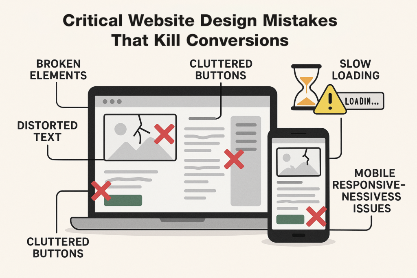
Cheap websites are typically built using templates that prioritise speed over strategy.
While they may look modern, they are rarely designed around:
- User intent
- Decision-making journeys
- Trust-building elements
As a result, traffic may arrive, but action does not follow.
This is conversion debt — when a website silently underperforms without obvious technical failure.
Businesses often attempt to compensate by increasing ad spend, adding popups, or changing copy. These tactics rarely address the underlying issue: the website was never designed to support conversion in the first place.
Cost #3: Performance and Maintenance Issues
Low-cost builds frequently rely on:
- Bloated themes
- Excessive plugins
- Poorly optimised code
Over time, this leads to slow load speeds, frequent errors, and compatibility issues.
Each small fix requires additional time, money, or external support. What began as a “simple website” turns into an ongoing maintenance burden.
More importantly, performance issues directly impact:
- User experience
- Search rankings
- Paid campaign effectiveness
These costs are rarely attributed to the website itself, but they originate there.
Cost #4: Brand Damage That Is Hard to Measure

A website is often the first meaningful interaction a potential customer has with a brand.
When that experience feels inconsistent, unclear, or unprofessional, trust is lost before a conversation ever begins.
This damage is subtle, but significant:
- High-quality leads hesitate
- Enterprise clients disengage
- Pricing power weakens
Brand perception is difficult to quantify, which is why it is often ignored. However, once trust is lost at the website level, it must be rebuilt through far more expensive channels.
Cost #5: The Redesign Premium
Eventually, most businesses outgrow their cheap website.
At this stage, the cost is no longer just about design. It includes:
- Rebuilding the site architecture
- Migrating content without losing SEO value
- Fixing technical limitations
- Repositioning the brand
In many cases, redesigning a poorly built website costs two to three times more than building it correctly from the beginning.
This is the redesign premium — the price paid for postponing strategic decisions.
Why “We’ll Fix It Later” Rarely Works
Websites are foundational assets. Decisions made early affect everything that follows — SEO, marketing, branding, and scalability.
When a website is treated as temporary, the business ends up operating on unstable ground.
Fixing issues later almost always involves undoing previous work. This is slower, more expensive, and more disruptive than building strategically from the start.
How Web Pundit Approaches Website Investment
At Web Pundit, websites are not treated as standalone deliverables. They are built as long-term business tools.
The approach focuses on:
- Clear positioning and messaging
- SEO-ready architecture
- Conversion-focused user journeys
- Scalable design systems
This ensures that the website supports growth rather than becoming an obstacle to it.
Conclusion: Cheap Websites Are Rarely Affordable
The true cost of a website is not its launch price.
It is the total cost of ownership over time.
Cheap websites defer critical decisions, accumulate hidden debt, and eventually demand expensive corrections.
Strategic websites require a higher initial investment, but they reduce risk, protect brand value, and support long-term growth.
In most cases, they are the more economical choice.
