The Founder’s Digital Marketing Strategy Playbook for 2026
A practical digital marketing strategy for 2026. Learn what founders should focus on, what to ignore, and how to build sustainable growth in a crowded digital landscape.
How Businesses Can Build Sustainable Growth in an Overcrowded Digital World
Introduction: Why Digital Marketing Feels Broken in 2026
By 2026, digital marketing has reached a paradox. Businesses have more tools, platforms, and automation than ever before, yet consistent growth feels harder to achieve. Marketing teams are publishing regularly, running ads across multiple platforms, experimenting with AI, and still struggling to see predictable outcomes.
This has led many founders to believe that digital marketing itself is broken. It is not.
What is broken is the way most businesses approach strategy. Execution has become easy. Decision-making has not.
In 2026, nearly every brand has access to the same ad platforms, the same AI tools, and the same publishing infrastructure. The real advantage no longer comes from activity, but from clarity. Knowing where to focus, when to focus, and what to deliberately ignore has become the defining factor between growth and stagnation.
This playbook is written for founders and decision-makers who want to build a digital marketing strategy that works in reality, not just on slides.
What Digital Marketing Strategy Really Means in 2026
A digital marketing strategy in 2026 is not a channel plan or a posting schedule. It is a framework for making decisions under pressure. Budgets are finite, attention is fragmented, and competition is intense across every industry.
At its core, strategy answers a small set of uncomfortable questions before execution begins. Who exactly are we trying to reach? What problem are we solving for them? What behaviour do we want to influence? And just as importantly, what are we choosing not to pursue right now?
Many businesses confuse activity with progress. They publish blogs, post on social media, and launch ad campaigns without alignment, creating movement without direction. In contrast, a clear strategy imposes focus. It forces trade-offs and sequencing.
The distinction between strategy and tactics becomes especially important in 2026, as shown below.
In mature digital markets, success increasingly comes from restraint. The strongest brands are not present everywhere. They are intentional about where they invest attention.
The Reality of Digital Marketing in 2026
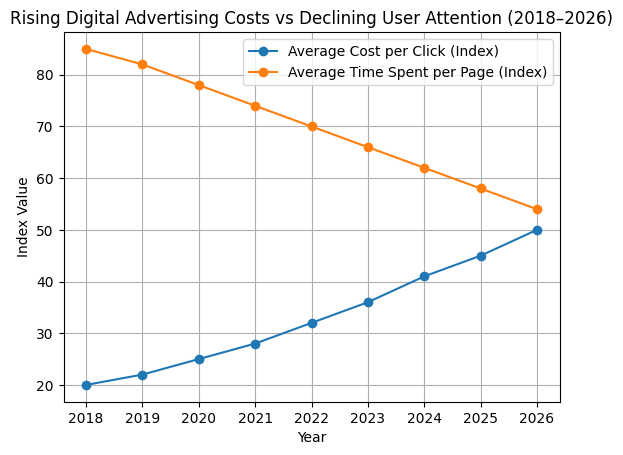
Digital marketing has matured, and maturity always brings friction. Organic reach is harder to earn, paid advertising costs have increased, and SEO requires deeper expertise and longer timelines. At the same time, AI has made content production easier, which has raised the baseline level of competition across every channel.
User behaviour has evolved in parallel. Audiences are more sceptical, more informed, and less tolerant of generic messaging. Buyers research extensively before engaging with sales, and trust is built over repeated, consistent touchpoints rather than one-off campaigns.
A useful way to visualise this shift is to look at the relationship between cost and attention over time.
Without a unifying strategy, marketing efforts become reactive. Brands chase platforms, replicate competitors, and mistake visibility for impact.
Why Business Stage Determines Strategy More Than Trends
One of the most common reasons digital marketing fails is misalignment between strategy and business stage. A bootstrapped startup does not need the same approach as a venture-funded SaaS company. A local service business should not replicate the content strategy of a global D2C brand.
In early stages, marketing exists to create clarity. Clear positioning, simple messaging, and a website that communicates value effectively matter more than scale. As businesses grow, lead generation and demand capture become priorities. At scale, efficiency, automation, and retention outweigh raw acquisition. Mature brands invest heavily in authority and long-term trust.
This progression can be summarised as follows:
In 2026, effective digital marketing is not about copying what works for others. It is about doing what fits your current reality.
Rethinking the Digital Marketing Stack for 2026
Rather than thinking in terms of platforms, modern strategies are better organised around intent. Every marketing activity plays a role in the buyer’s journey, whether that role is discovery, conversion, trust-building, or retention.
Problems arise when businesses activate channels without understanding their purpose. When intent is unclear, marketing becomes fragmented. When intent is aligned, growth becomes repeatable.
Most businesses fail not because they lack channels, but because they attempt to activate all of them simultaneously, without sequencing or ownership.
SEO in 2026: Still Relevant, but Fundamentally Different
SEO remains one of the strongest long-term growth channels, but its mechanics have changed. Ranking is no longer driven by publishing high volumes of keyword-focused content. Instead, search engines prioritise authority, depth, and credibility across topics.
In 2026, SEO success depends on demonstrating genuine expertise. Thin content, mass-produced AI blogs, and isolated keyword targeting rarely perform. Brands that invest in fewer, deeper pieces of content supported by strong internal linking and clear topical focus continue to see results.
Another important shift is intent alignment. Traffic alone is no longer the goal. SEO strategies must support business outcomes such as leads, sign-ups, or revenue.
SEO is not obsolete. Outdated SEO playbooks are.
Paid Marketing in 2026: Precision Over Scale
Paid advertising remains one of the fastest ways to generate demand, but it is also one of the most expensive mistakes when executed without preparation. In 2026, most ad campaigns fail not because of targeting or creative, but because of weak foundations after the click.
Landing pages that lack clarity, slow websites, and poorly defined offers erode performance long before ad platforms become the issue. Scaling spend without validation increases costs without improving outcomes.
Interpretation: optimisation below the ad level often yields higher ROI than increasing ad spend.
Paid marketing works best when it amplifies something that already converts.
Content Marketing in 2026: Depth Beats Frequency
Content marketing has not lost relevance, but it has lost tolerance for mediocrity. Publishing frequently without substance no longer builds visibility or trust.
High-performing content in 2026 reflects experience. It communicates insight rather than information. Founder-led perspectives, original thinking, and practical explanations consistently outperform generic brand posts.
Equally important is distribution. A single well-researched article, repurposed thoughtfully across platforms, often outperforms constant publishing with little amplification.
Content today is not about feeding algorithms. It is about earning attention.
The Role of AI in Digital Marketing Strategy
AI has reduced the cost and time required for execution, but it has not replaced strategic thinking. In fact, the widespread use of AI has made differentiation harder, not easier.
AI is effective for research, drafting, reporting, and automation. However, positioning, prioritisation, and decision-making still require human judgment. Businesses that rely entirely on AI-generated output struggle to stand out because they produce the same patterns as everyone else.
In 2026, AI functions best as a force multiplier. It strengthens clear strategies and exposes weak ones.
A Practical Way to Think About the First 90 Days
Effective strategies are implemented in phases. The first phase focuses on foundations such as messaging clarity, website experience, and measurement. The second phase concentrates on executing one primary growth channel consistently. The third phase emphasises optimisation and preparation for scale.
This sequencing prevents overwhelm and ensures that effort compounds rather than fragments.
The Web Pundit Perspective
At Web Pundit, we consistently see that businesses do not fail due to lack of effort. They fail due to lack of structure. Marketing becomes scattered when strategy is unclear.
Our philosophy is simple: strategy should simplify, not complicate. Sustainable growth in 2026 comes from focus, sequencing, and clarity, not constant activity.
Digital marketing in 2026 rewards businesses that think before they act. Tools will evolve. Platforms will change. AI will become more powerful. But the fundamentals remain constant.
Clear thinking beats constant activity.
Direction beats noise.
Focus beats everything else.
